
ToolDance X1: What Its $10M Launch Really Signals
The hardware proposition is unusually aggressive: a large enclosed work area, automatic tool changing and optional five-axis machining for less than established three-axis rivals. That makes the value compelling—and the execution burden unusually high.
Nearly 2,000 backers committed at professional-equipment pricing during the opening surge. That combination of speed, participation and average pledge size is unusually strong evidence of early demand for a more automated desktop CNC platform.
The average is not a single-machine selling price: pledges may include premium bundles, twin packs and accessories. VIP deposits, launch incentives and concentrated promotion may also amplify the opening result. Funding momentum does not validate manufacturing, software, service or on-time delivery.
A serious machine specification attached to first-generation delivery risk.
On paper, ToolDance X1 compresses capabilities normally spread across a mill, tool changer, probing system and optional rotary hardware into one enclosed platform. The starting reward is difficult to ignore. But the funding total proves demand, not repeatability, software maturity, service capacity or the team's ability to manufacture more than two thousand complex machines on schedule.
What is ToolDance X1 actually selling?
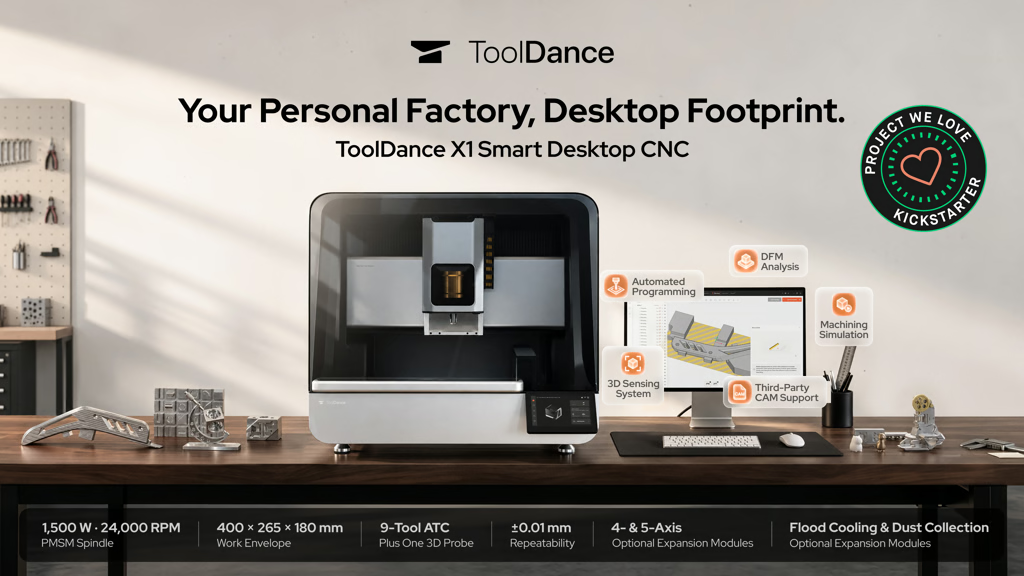
ToolDance X1 is an enclosed desktop CNC mill aimed at creators, engineering teams and small workshops that want to machine aluminum and, under suitable conditions, harder metals without moving to a conventional industrial machining center. The base machine includes a 1,500 W S1-rated spindle, a nominal 400 × 265 × 180 mm three-axis work envelope, a nine-position RFID automatic tool changer, a touch probe and ToolDance Studio software.
The platform is modular. Buyers can add a fourth-axis unit for rotary work, a five-axis module for positional and simultaneous machining, or choose either a dry dust-collection setup or a flood-coolant and chip-management system. Those choices materially change both price and the kinds of materials and geometry the machine is suited to handle.
The most important distinction is that the published performance remains a maker claim. ToolDance has released machining demonstrations and selected measurement results, but CrowdTechDaily has not seen a long-duration independent review of a production unit covering rigidity, thermal drift, tool-change reliability, software stability and serviceability together.
Three claims that matter most
The base hardware rewrites the desktop-CNC value equation—if it reaches production intact
ToolDance specifies a 1,500 W spindle running up to 24,000 RPM, a 400 × 265 × 180 mm three-axis envelope and ±0.01 mm repeatability. Every X1 is also said to include a nine-position RFID tool changer, probe and tool setter. Those figures materially exceed many established desktop mills on spindle power and working volume, but they should not be read as an independent guarantee of accuracy under load. At 120 V, the maker says spindle output falls to roughly 900–1,000 W, which is an important regional qualification to the headline number.
ToolDance Studio may matter more than the spindle
The software pitch connects design review, manufacturability checks, workholding guidance, simulation, probing and AutoCAM. That could lower setup friction for users coming from 3D printing or outsourced machining. Yet CAM software is also a long-term product: post-processing, collision avoidance, tool libraries, operating-system support and updates must remain dependable after the campaign excitement fades. The FAQ says fully automated 3+2 programming is still in development, while current workflows rely on interactive programming for precision mechanical parts.
The modular axis and chip-control options are useful—but they are different machines in practice
A base X1 with air blast is not equivalent to a five-axis flood-cooled configuration. The optional fourth axis adds rotary work, while the five-axis module supports positional and simultaneous motion within a smaller usable envelope. Dry dust collection suits wood, plastics and composites; flood coolant is the more relevant configuration for sustained metal cutting. Buyers should choose around actual parts, fixtures, power and cleanup requirements rather than treating every campaign demonstration as representative of the US$2,999 base reward.
Which ToolDance X1 bundle fits the work?
| Kickstarter reward | Pledge | Added motion | Chip or coolant system |
|---|---|---|---|
| ToolDance X1 | US$2,999 | 3-axis | Air blast; neither optional module |
| 4-Axis Clean-Cut Deluxe | US$4,049 | 4-axis | Dust collection and filtration |
| 4-Axis Flood Deluxe | US$4,349 | 4-axis | Flood cooling and chip management |
| 5-Axis Clean-Cut Deluxe | US$4,449 | 5-axis | Dust collection and filtration |
| 5-Axis Flood Deluxe | US$4,749 | 5-axis | Flood cooling and chip management |
Industry outlook: desktop CNC is moving from hobby routing toward automated small-batch machining
ToolDance is entering a category already shaped by machines such as Makera Carvera and Bantam Tools' Desktop CNC. Makera currently lists Carvera at US$5,799 with a 200 W spindle, 360 × 240 × 140 mm work area, six-tool ATC and optional fourth axis. Bantam Tools lists its three-axis dry mill at US$6,999 with a 250 W spindle and a smaller 178 × 229 × 83 mm work volume. Against those official listings, X1's US$2,999 base reward and 1,500 W headline specification are unusually aggressive.
That comparison is not an automatic victory. The established products are purchasable systems with documented workflows and support histories; X1 is a crowdfunding reward whose final production quality, service logistics and software life cycle remain unproven. The practical buying decision is therefore not simply watts per dollar. It is whether a backer values broader capability enough to assume early-stage delivery and support risk.
The category direction is credible: automatic probing, guided CAM, enclosed chip control and tool changing can make subtractive manufacturing more approachable to product designers and small teams. The companies that win will be the ones that turn impressive metal-cutting demonstrations into repeatable workflows, clear electrical and safety documentation, available replacement parts and software that remains usable for years.
What should make a backer pause?
Who should consider it?
Technically confident makers, product-development teams and small workshops that can evaluate tooling, fixtures, electrical requirements and CAM limitations—and can tolerate first-generation crowdfunding risk in exchange for unusually broad capability per dollar.
Buyers who need a production-proven machine on a fixed date, require local service or validated tolerances, lack a suitable electrical circuit and workbench, or expect the base reward to reproduce every five-axis and flood-coolant demonstration shown in the campaign.
Five questions to ask before pledging
- How many production-intent X1 units have completed endurance testing, and what failure rates have been observed for the spindle, ATC, probes and rotary modules?
- What outlet, circuit and power cord are required in my country, and which published cutting results remain achievable on 120 V?
- Which ToolDance Studio and AutoCAM functions will be production-ready at shipment, and what remains in development or dependent on a cloud service?
- What is the final shipping charge to my destination, who handles import paperwork, and exactly which duties or taxes are covered?
- Where will warranty repairs be performed, who pays freight for a heavy machine, and which wear parts and replacement modules will be stocked?
The price is the attraction; execution evidence should make the decision.
ToolDance X1 has one of the strongest desktop-CNC propositions CrowdTechDaily has seen on paper. The base reward undercuts established rivals while promising a larger envelope, more spindle power and automatic tooling. But the gap between a campaign specification and a dependable machining platform is large. Back only if the exact bundle fits your materials and power setup—and if you are comfortable funding the team's proof of manufacturing, software and service at scale.
This article is based on the live Kickstarter campaign, rewards, FAQ, ToolDance's official materials and competitor product pages available on Oct. 16, 2026. CrowdTechDaily did not physically test ToolDance X1. Campaign totals can change, published machining performance remains subject to tooling and setup, delivery dates are estimates and Kickstarter pledges are not retail purchases. Campaign totals, reward prices, deadlines and delivery estimates came from Kickstarter. ToolDance's spindle, repeatability, material, software and multi-axis statements are maker claims unless explicitly identified otherwise. Competitor prices and specifications came from official Makera and Bantam Tools product pages. Some third-party coverage was sponsored or based on supplied demonstrations; it was used to define the evidence boundary, not as independent validation. Images remain the property of ToolDance.