
CyboPal ONE: the monitor that follows you—or a $1,599 software bet?
A six-axis arm can make a screen feel unusually responsive. But CyboPal ONE asks backers to trust an ambitious stack of robotics, sensing and desktop software on a fast delivery schedule.
A genuinely different workstation idea with unusually concentrated execution risk.
CyboPal ONE is more than a monitor arm, but that is also the problem: the experience depends on motion hardware, safety sensing, voice and gesture recognition, a cross-platform client and reliable support all working together. The campaign proves interest, not readiness.
What is CyboPal ONE actually selling?
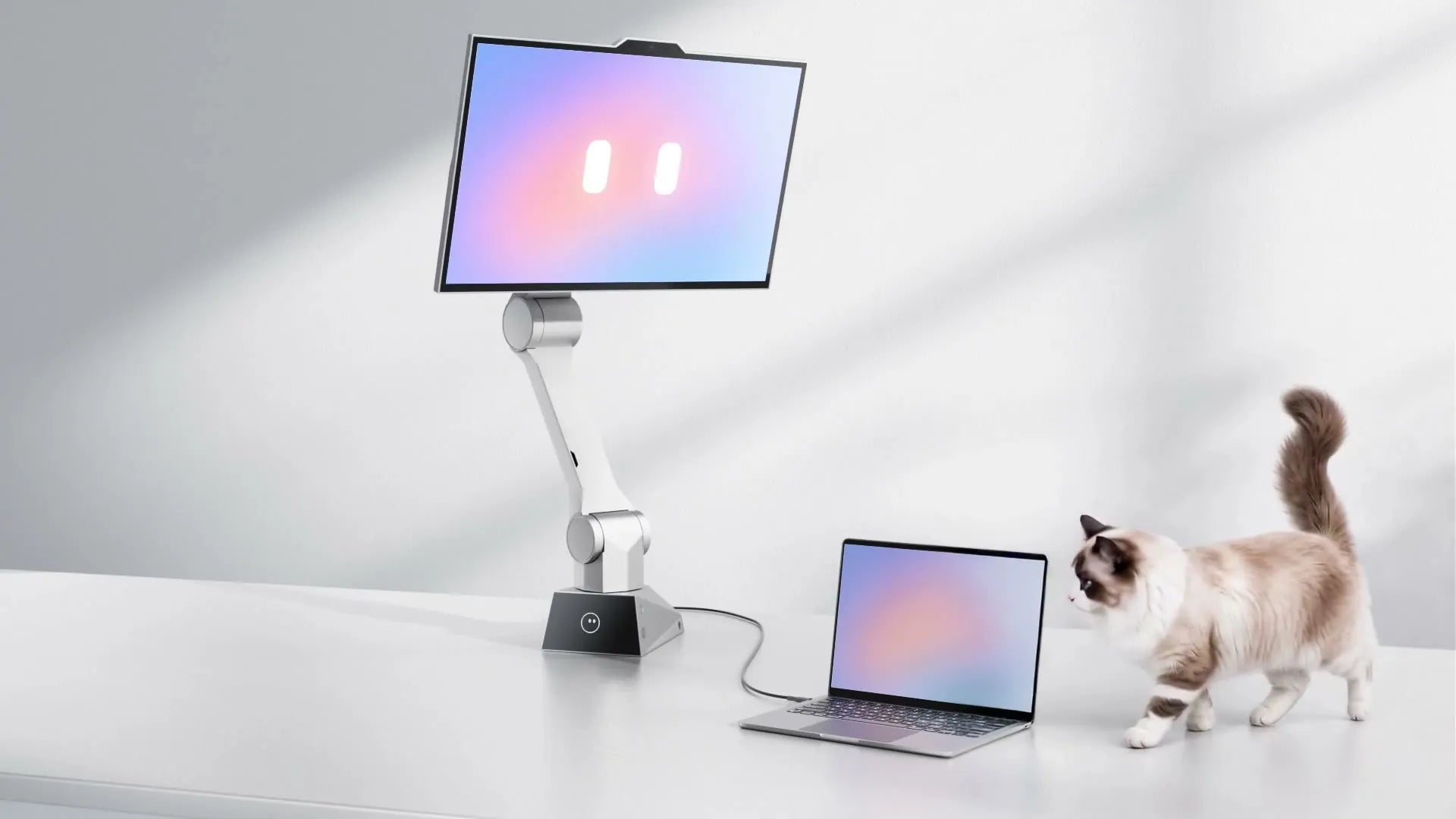
CyboPal ONE is an integrated 27-inch 4K display attached to a motorized six-axis arm, with a Linux-based compute unit dedicated to tracking, motion control and AI features. It connects to an existing laptop or desktop over USB-C or HDMI; the built-in computer does not replace the machine that runs your normal work.
The pitch is an adaptive workstation: the display can follow posture changes, recall saved positions, rotate between orientations and respond to voice or gesture commands. The standard package includes the display, robotic body, compute base and a C-clamp mount.
That makes the product closer to a tightly integrated robotics platform than to a conventional monitor. Its value will depend less on one headline specification and more on quiet motion, safe path planning, low-friction software and dependable calibration over time.
Three claims that matter most
The screen adapts instead of making the user adapt
CyboPal lists a 747 mm reach, face tracking in under four seconds, zero-force manual adjustment and voice-triggered position presets. Those features could reduce repetitive monitor adjustment for people who alternate between sitting, standing and reclining. Campaign demonstrations show the intended behavior, but CrowdTechDaily has not independently measured tracking speed, noise, repeatability or long-session comfort.
Local sensing is meant to make an always-present device feel less invasive
The maker says visual tracking, gesture recognition and spatial processing run locally on an eight-core ARM platform with 8 GB of RAM and 128 GB of storage. It also describes a Privacy Mode that physically cuts power to the camera and microphones. That is a stronger design signal than a software-only indicator, but buyers should still ask what telemetry leaves the device, which features require cloud access and whether privacy behavior is independently auditable.
Voice, gesture and desktop automation form the real product moat
CyboPal presents voice commands for moving the display, arranging windows, adjusting brightness and dictating text, plus gestures for zooming and scrolling. Hardware competitors can copy a motorized arm; the harder advantage is a reliable client across Windows, macOS and Linux. The campaign materials demonstrate workflows, not production-grade latency, application compatibility or long-term update support.
Industry outlook: an adaptive-computing experiment, not yet a settled category
CyboPal does not have an obvious like-for-like rival. Conventional ergonomic arms such as the Ergotron LX let users reposition existing monitors manually, while products such as LG StanbyME package a movable screen and software into a lifestyle display. Neither provides CyboPal's combination of automated six-axis desk motion, sensing and desktop control.
That absence of direct competition is not automatic proof of a moat. It may indicate a category opportunity, or it may mean most buyers prefer a cheaper modular setup with fewer failure points. At US$1,599, the practical comparison is not only another monitor: it is a good 27-inch display, a proven arm and the decision to adjust them manually.
The longer-term opportunity is real if adaptive displays can serve posture-changing knowledge workers, creators, remote-presence use cases and people with limited mobility. The commercial test will be whether the active movement becomes useful infrastructure rather than an impressive demo that users eventually disable.
What should make a backer pause?
Who should consider it?
Early adopters who change posture frequently, value desk automation and are comfortable backing first-generation robotics hardware with unresolved delivery and support questions.
Buyers who mainly want a high-quality 27-inch monitor, need proven workplace reliability, dislike cameras at the desk or expect the built-in AI computer to replace their PC.
Five questions to ask before pledging
- Which features work fully offline, and exactly what data or telemetry is sent to CyboPal or third-party cloud services?
- What independent safety, electrical and display certifications will be completed before rewards ship?
- What are the warranty process, return location, shipping responsibility and expected repair turnaround in my country?
- Which Windows, macOS and Linux versions will the client support at delivery, and how long are software updates planned?
- Can the display, robotic joints, sensors and compute base be replaced separately, and what will common out-of-warranty parts cost?
Back the workflow only if you are comfortable funding the proof.
CyboPal ONE has a more coherent idea than many AI-hardware campaigns: sensing, movement and software all serve an adaptive screen. Yet the same integration multiplies failure points. The sensible decision turns on independent safety evidence, software readiness and a credible service plan—not on the campaign's funding multiple.
This article is based on public campaign, FAQ, official product and third-party reporting available on Oct. 14, 2026. CrowdTechDaily did not physically test CyboPal ONE. Campaign totals can change, reward delivery dates are estimates and Kickstarter pledges are not retail purchases. Confirmed campaign data came from Kickstarter. Hardware and privacy specifications are maker claims from CyboPal and its campaign FAQ. Category comparisons used official LG and Ergotron materials; the independent-testing boundary was cross-checked against TechRadar. Images remain the property of CyboPal.