
HeyGears G1X Review: Full-Color 3D Meets UV Printing
The G1X combines vivid UV output, raised textures and full-color 3D printing. Early results are promising, but mode changes remain manual and production delivery is still unproven.
A genuinely unusual machine with a genuinely demanding workflow.
G1X is not merely a resin printer with a color accessory. Its combination of inkjet deposition, UV curing and multiple material paths could be valuable to customization studios that already know why they need it. But the record-breaking campaign total does not prove production reliability, and early testing shows that moving between its headline workflows involves hands-on changeover, maintenance and calibration.
What is the HeyGears G1 Series actually selling?
The G1 Series is a desktop UV-printing platform offered in two main hardware families. The entry G1 uses an F1080/XP600 printhead with six channels and supports conventional 2D UV and raised-texture work. G1X moves to an Epson i3200 printhead with eight channels, higher claimed resolution and an upgrade path to full-color 3D printing.
The important package distinction is easy to miss. G1X Starter does not include everything needed for full-color 3D output; it requires the Resin Station and 3D Resin Kit supplied with the $3,599 G1X Full-3D package or bought later. The $4,999 Deluxe tier adds a relay ink-and-resin hub plus roll-to-film and transfer accessories.
HeyGears says the machine builds colored objects by depositing material with piezo inkjet heads and curing each layer with UV light. That differs from painting a conventional resin print after production. It also means buyers are committing to a more specialized ecosystem of printheads, inks, resin, cleaning routines and color-management software than a typical hobby printer requires.
Three claims that matter most
One footprint can cover three distinct production jobs
HeyGears positions G1X for direct 2D printing, raised textures and full-color 3D objects, with a stated open-flatbed work area up to 330 × 420 × 130 mm and G1X resolution up to 1440 × 2400 DPI. That combination could replace several outsourced steps for studios producing miniatures, prototypes, signage, packaging samples or personalized merchandise. The dimensions and resolution are manufacturer specifications; CrowdTechDaily has not independently measured output accuracy, color gamut or throughput.
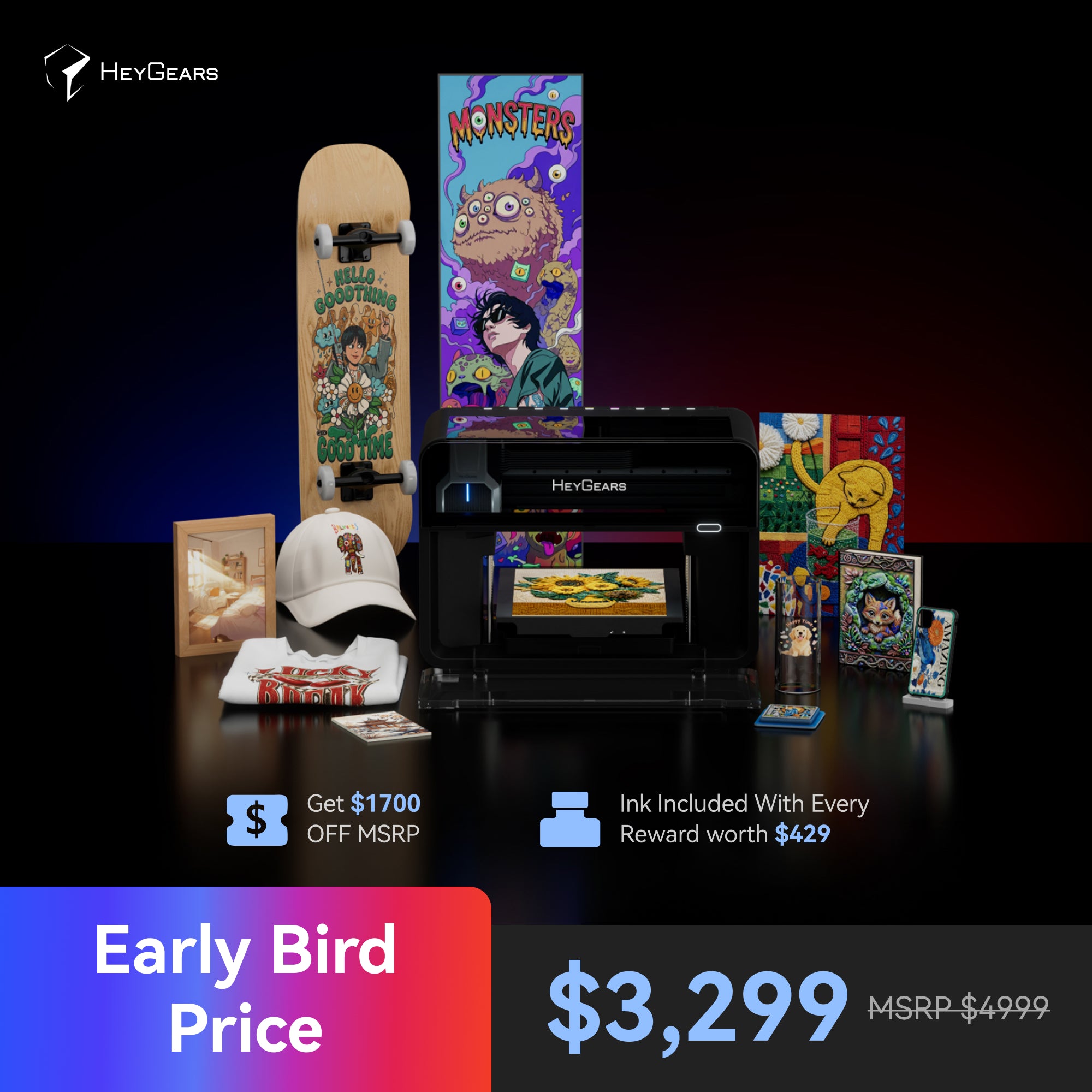
The color result appears promising, but detail has a trade-off
A pre-production hands-on report from FauxHammer found the 2D UV results impressive and the full-color 3D capability distinctive. The same report says current 3D detail does not match leading monochrome resin printers. That is a rational compromise if finished color is the goal, but it matters for miniature buyers who may assume the G1X is simultaneously a best-in-class detail printer and an automatic coloring system.
The advertised multi-function convenience is not one-click
Official documentation says G1 and G1X workflows use different ink configurations, while early hands-on testing describes a manual switch between 2D UV and full-color 3D work: assemblies are changed, material is purged, a nozzle check is run and calibration follows. This does not invalidate the concept, but it changes the value proposition from an appliance to a compact production system that needs an operator.
Which campaign package was designed for what?
| Package | Campaign price | Print system | Full-color 3D out of box |
|---|---|---|---|
| G1 Starter | $1,999 | F1080/XP600, 6 channels | No |
| G1X Starter | $3,299 | Epson i3200, 8 channels | No; upgradeable |
| G1X Full-3D | $3,599 | Epson i3200 plus Resin Station and 3D kit | Yes |
Industry outlook: color is the breakthrough, workflow is the test
Affordable desktop 3D printing has improved rapidly in speed and surface detail, but convincing full-color output is still uncommon. Most creators either print in one material and paint by hand, assemble parts in several colors or outsource expensive industrial color printing. G1X is compelling because it tries to move that last option onto a studio desk.
The opportunity is strongest where color itself creates commercial value: character models, architectural prototypes, branded samples, tactile graphics and small personalized production runs. In those settings, avoiding manual painting or outsourced print queues could justify a machine that costs more and requires tighter process control.
The risk is that a broad capability list hides the cost of operating each mode well. Reliable color requires profiles, controlled substrates and stable consumables; UV printing adds cleaning and waste handling; full-color 3D adds resin handling and layer-quality constraints. A machine can technically perform all three jobs without making every job economical.
What should make a backer pause?
Who should consider it?
Established customization shops, product-design studios and miniature or prototype businesses that have a validated need for finished color, can manage UV materials and are prepared to document an operating workflow.
Casual beginners expecting appliance-like operation, buyers who mainly want maximum unpainted resin detail, or anyone without a suitable workspace, maintenance tolerance and budget for proprietary consumables.
Five questions to ask before pledging
- What exact steps, time and material waste should I expect when switching between 2D UV and full-color 3D modes?
- Will production software support custom ICC profiles at delivery, and which file formats and operating systems are fully supported?
- What are the official ink, resin, cleaning-fluid and replacement-printhead prices in my region, including typical consumption per job?
- Which ventilation, PPE and waste-disposal practices does HeyGears require for home, studio and commercial use?
- Where will warranty repairs be handled, who pays freight and how quickly can consumables and printheads be supplied after the campaign? Which test settings produced the campaign's 3× speed claim and the later up-to-12× marketing claim?
The G1X looks most credible as a small production system, not a magical all-in-one printer.
HeyGears has shown enough working output to make G1X more than a rendering-led concept, and its full-color 3D capability is meaningfully different from ordinary desktop resin printing. The cautious view is still warranted: beta evidence is not production evidence, the workflow requires real operator involvement, and the cost case depends on consumables and support that the campaign total cannot validate. Existing businesses with a specific color-production bottleneck have the clearest reason to consider it; hobbyists attracted mainly by the spectacle should wait for production-unit reviews and operating-cost data.
This article is based on the public Kickstarter campaign, official HeyGears documentation and third-party early hands-on reporting available on Oct. 15, 2026. CrowdTechDaily did not physically test the G1 Series. The Kickstarter campaign ended on Sep. 11, 2026; delivery dates, production specifications and performance claims may still change. Crowdfunding pledges are not equivalent to retail purchases. Campaign totals and timing were confirmed from Kickstarter. Model, workflow, delivery, shipping and material specifications are HeyGears claims from the campaign FAQ and official product page. Early operational observations came from FauxHammer's disclosed pre-production hands-on review. The featured image is official HeyGears product material and remains the owner's property.